Saturday, December 5, 2015

Post 5- Céline Sciamma

Céline Sciamma 
Céline Sciamma is a French screenwriter and film director. Her career began relatively recently, with her debut as screenwriter and director in the film, Water Lillies (2007). She is also well-known for her films Tomboy (2011) and the critically acclaimed Girlhood (2014). Her style of filmmaking puts emphasis on coming-of-age films, typically focused on youth and adolescents. Her more recent films, however, highlight gender fluidity and sexual identity among girls in contemporary society. 
On feminism, Sciamma says, "It's an important social issue... Equality for women is a real social change--the last one we can maybe achieve that will matter, that will actually change things." She goes further to state that in popular media, "[feminism] is always presented as women getting revenge or women getting privilege--as though it only concerns women, or women in countries where they'd be oppressed. Feminism isn't that. It concerns us all. It'd be a great improvement for men too, actually." To be perfectly honest, I had never heard of Sciamma as a director. Only quite recently have I heard of her film, Girlhood, in its proper representation of black characters. After having learned more about her and her other works, I have come to have a deep respect for her.

In Girlhood, Sciamma tackles not the black experience, but the trials of youth using black characters.  In France, Sciamma's decision to show "the margin" made headlines. On her decision, she says, "I picked black girls because I was struck by the lack of representation of black women, and characters, onscreen in France, and Europe also. Especially in Paris, where I live, [it's] actually a very mixed society. I wanted to go for it, but not saying,  "Oh, I'm going to depict what it's like to be a black girl," but actually saying, "I'm going to depict what it's like to be a girl," and why can't that be with a black character?"

I personally feel that this is the mindset that most directors should aspire to have in regards to representation of women and race in film. Her films go on to address real stories and issues prevalent in society's youth, and it's about time we understand what they're going through. Girlhood is just one of several of her films which pass the Bechdel test. Discovering this director has truly been an enlightening experience. 

Works Cited:
http://bit.ly/1DnEyar


Theater Director - Jenna Worsham

So I’m note sure if this actually fits the criteria for this blog-post, but its pretty badass and I wanted to share this young woman’s work with you:

One of my dear friends and colleagues, Jenna Worsham is a theater director. She discovered her passion for directing as an undergraduate at Washington & Lee University. Post graduation, Jenna moved to New York to pursue a career in theater and has since found herself devoted to the male-dominated craft of stage directing. She has directed on full-productions, workshops, and development projects, as assisted numerous on and off Broadway. However, some of her greatest successes thus far have been her social advocacy projects.

In April and May of last year, Jenna reinvented Eve Ensler’s The Vagina Monologues. This project took formally incarcerated women and placed them on stage next to actresses and activists calling attention and support to women involved in the criminal justice system through Ensler's work. The first performance was sight specific and took place at Taconic Correctional Facility as part of V-Day. The second performance took place at Cherry Lane Theater in the West Village and was a benefit for the Women’s Prison Association.


Most recently, Jenna has continued working with these women, however this time instead of telling stories already written, she help develop a project based on the lives of formally incarcerated women. Titled Here to be Seen: Women and Justice the project was developed over several months. It took the stories of seven women who had lived through years of incarceration and paired them with seven playwrights. After conversation guided by Jenna the writers were then challenged to tell theatrical accounts about the realities of these women’s incarcerations, daily lives, and struggles, not just at prisoners, but as women. Once again in November 2015, these women took the stage along side actors and activist, but this time at the Brooklyn DA’s office. They performed scenes and monologues and read little known statistics to create a true image of these women.


Footage of last week's collection of stories of formerly incarcerated women.
Posted by Johnny Perez on Saturday, November 21, 2015

This type of work is refreshing and important. Not only did it grab attention of the local and state government, but also it gave women with otherwise unheard and stereotyped voices a forum to be heard and seen. In the Q & A after the event it was clear that this work had made an impact. A few of the women admitted that because of this workshop they now feel the can move forward because their voices matter. Audience members stood in shock admitting there assumptions about women in prison and asking how this work will be perceived beyond the walls of the DA.

Personally, even I was surprise the extend I drew conclusions about formal incarcerated women without understanding them. We tend to forget the mothers, and daughters, and wives and lovers with interests and passions and jokes to tell. We don’t recognize the struggles the face as a result of their incarceration or the struggles they faced that got them there. Personal, I was very black and white on the matter without truly thinking about it. Speaking with Jenna about this project, she hopes to carry it forward beyond just Brooklyn. I told her about my experience, and guilt that came along with it and learned her experience was similar. However, she believes that’s why her work is important – it provides women with a forum to explore, feel and united. Jenna and her collaborators believe this work should make you uncomfortable and that this is the only way change will happen.

Friday, December 4, 2015

Post 5 - Nadia Tass

Film Director Nadia Tass

Nadia Tass is a film director and producer from Australia. Actually, Tass started her career as an actress. Later, she expanded her horizons to be director and producer. She has a passion for film and successfully turned her passion into film.  As we know, male dominates the film and theatre industries. Tass faces so many challenges, such as gender discrimination, etc., just like she says, “It is unequal, yes. There are far more men in my industries.” Tass goes through obstacles to finish her majority works in this male-dominated field. Her gender offers her great point of view from a female perspective. Her experience tells me that she is a legend of feminism. She says, “"The female has to be pretty strong to tell a group of male executives 'OK now, you have to listen to me. This is how the script is and you need to come over to my perspective and see it for how it is because I think this version is really important'."
        
                 I appreciate her positive attitude while facing challenges. I can tell her characteristic when watching her films. For example, Tass directed Samantha: An American Girl Holiday, the first in the series of An American Girl films. The film is about friendship of wealthy Samantha and poor Nellie. It passes the Bechdel Test. The film has two main female characters Samantha and Nellie. They become good friends and help each other. Through the Samantha’s journey, Tass did a great job in dealing with a lot of social issues such as death of beloved, class bias, sweatshop, child labor, rich and poor, etc.


                 The film has a strong social conscience as well as Tass. When Samantha finds Nellie working in a sweatshop with a horrible environment, she not only rescues her friend, but also trying her utmost best to stop child abuse. I learn more about Tass through Samantha. I believe that they have similar characteristics, especially never give up while facing challenges. There is a saying in traditional Chinese culture, "The art work carried all messages of the artist." Tass is a perfect example.

Citation:


Thursday, December 3, 2015

Nine to Five (1980)

My favorite line. Dolly teaching a bigot some manners
I was having a darn hard time finding a film which discussed feminist issues directly that I had seen recently. Yes, I could have picked Mad Max but I guessed everyone else was gonna do that movie. So I did some research, found a link which had a list of feminist movies to watch on Netflix. Well it should be to no surprise for anyone who knows me that when I saw my girl Dolly I just had to watch it, and accompanied by Jane Fonda and Lily Tomlin, it would be a sin not to.

The screenwriting for this film was done by Patricia Resnick and Colin Higgins. Resnick was also a consulting producer for Mad Men as well as the television show Olivia. Resnick shares her experiences on her website and depicts how she was able to break through her own glass ceiling. The script for Nine to Five exhibited lots of foreshadowing, rich comedic moments, and realistic feminist issues which resonated from perhaps personal experiences. She gave each character a unique voice as well as a relatable backstory adding depth to all the characters. Opening weekend Nine to Five earned a total of $3.9 million and is the 20th highest grossing comedy film. The film was so good that it even became a musical ( I must have been living under a rock because I had never heard of either).

Mr. Hart's other name as explained by Judy.
The film focuses on but is not limited to the lives of three women who very uniquely (no spoilers) are able to take over their office and make living better for the employees. (Okay here they come) Dolly's character Doralee is happily married but is being sexually harassed by her boss Mr. Hart. He spread a rumor that they are having an affair and people mistreat her because they believe she is a traitor. This issue shines light on victim shaming that often happens in the workplace. Through Judy, a recently divorced housewife who was the victim of an unfaithful spouse was forced to make a living, the audience learns how even inexperienced women are able to manage just like the men. Lastly, through Violet, Lily Tomlin, we see the depiction of the glass ceiling and how women are mistreated just because of their gender. Although these women are all white we do see a presence of diversity in this office. Women and men of color are also given minor speaking roles but some are also given back stories.

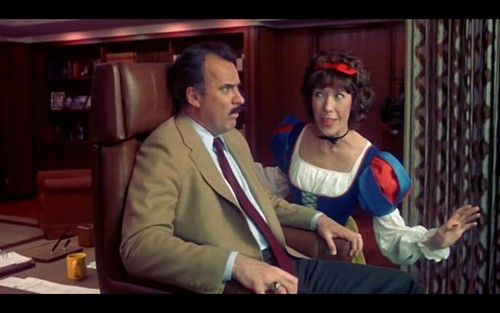
Violet as the vengeful Snow White
I think my favorite thing about this film is that each character is unique in their own way. Each of the main women are given a fantasy in which they kill their boss and in this one scene they flip the script on him. Judy, the timid new girl becomes a hunter, Doralee becomes a cowgirl who gets to rangle her own bull, and Violet becomes a princess who is no damsel. The film does something very clever with these scenarios as well which is all part of the great script.There are more women on screen than men through the majority of the film and they aren't just speaking about their love for another man. Women are depicted as people who suffer and struggle just like men. They even have a character who struggles with alcoholism whom they help reform. I often hesitate when visiting past comedies because I fear encountering racism and stereotypes but this film was quite enjoyable. What I would love to see is remake of this film with women of color and trans women playing the leads.

Tuesday, December 1, 2015

She Makes Comics - Post 5


     Throughout the course of research for my final project, I stumbled across a very appropriate documentary called 'She Makes Comics' which focuses on the pioneering accomplishments of various women who have worked in the comics industry from the 1950s to today. I highly recommend this documentary to the students of our class, or really anyone who is interested in media history. While the movie touches on many careers, for the purposes of this post I have decided to showcase three of the artists featured.

     Early on in the film we are introduced to Ramona Fradon, a comic book artist who started drawing for DC comics in the 1950s. Ramona was known for being one of the first women to regularly illustrate a superhero title for a major publisher. Her breakout superhero was Aquaman. She was also the creator of the hero 'Metamorpho'. It becomes clear during the interviews with other artists, that Ramona was hugely influential to them personally, and is also credited with making room for women artists during the early days of the industry.


     Another artist we meet is cosplay pioneer Wendy Pini. During the first comic-cons in the 1970s, Wendy would perform a stage show as the fantasy character 'Red Sonja' for the con audience. The show became so popular that other women started to also dress like Sonja during the conventions. This in turn inspired others to create costumes of their favorite heroes and gave them the confidence to share their creations with other fans. The documentary frames this as the birth of cosplay and it makes sense as it's presented within the context of comic and fantasy conventions.


     Wendy's first job in the comic industry was to write an issue of the 'Red Sonja' comic book because the publishers had been so impressed with her live performances as Sonja that they approached her to come up with a story. It was this gig that gave Wendy the inspiration to create her own series ElfQuest. When pitched to DC and Marvel, ElfQuest was rejected by them as being too strange, so Wendy decided to self publish the series ElfQuest, which was and still is supremely popular among young girls. ElfQuest has been running for 36+ years, and was one of the very first comic books to be created and self published by a woman.


     In 1976 DC Comics hired 28 year old Jenette Kahn as publisher, and she went on to become president of DC in 1981, the youngest person in the company to ever be president of a division and the first woman. Before Kahn, the prevailing idea behind selling comic books were that they were made for children. Jenette had the approach that comics were a medium for telling stories, and that these stories could be crafted for people of all ages. This was revolutionary in the world of comics, as it was the first time we had comics for adults that were legitimate, and not the product of underground comics movements.


     Because of this radical change, the medium itself of comics and graphic novels was pushed to new horizons that resulted in some of the most influential comics of all time. The movie lists 'The Watchmen' and 'The Dark Knight Returns' as the best products of this period. This emphasis on storytelling led to the creation of the 'Vertigo' imprint which brought comic storytelling to adults, and paved the way for other adult themed imprints.

She Makes Comics ($10)