Wednesday, December 9, 2015

Post 4 - The Hypocrisy of Patriarchy


Living in a patriarchy, I must acknowledge that men are granted a good degree of control over their body and how they look (McIntosh 1).  Men generally will not be discriminated against for the way they naturally appear or the clothes they happen to like.  They will not lose a job to another male because he had six packs and was a hunk.  They will be based on merit and skill alone.  Conversely, women are constantly judged for the way they look, it seems to be the only quality that the patriarchy deigns to care for.  A skilled conventionally unattractive woman could easily lose a position to a less skilled, more attractive lady because the interviewer happened to like the way she looked.  When men aren't expected to look attractive, but men are, we end up with Lois marrying Peter, Marge marrying Homer, and Peggy marrying Al.  Through media, these differences in gender roles are recodified, repeated, and reinforced so it becomes the norm.  However, only the fictional characters depicted in the media can inhabit the ideal woman that society expects.  That is because patriarchy often operates along dichotomous lines, but it hypocritically expects members of its societies to inhabit both sides of the binary.  So many things are expected of women that it is nigh impossible to satisfy every person’s requirements.  There are conflicting standards for almost every aspect of the female experience. Yet, it is most explicit within the issue of women’s rights over their bodies, as well as the cascading topics covered by this term.   

In regards to the way that women present themselves, women are always expected to be sexy and uninviting, yet modest.
A propaganda piece trying to convince
women that fighting for agency
forces them to lose their femininity
How is this possible and who determines whether this line is crossed? I usually talk about the "patriarchy" is if it is a bureaucratic organization that lays down all these rules, but it's really just vague social rules we have all internalized.  Therefore, everyone will have a different opinion on what is appropriate or "slutty." If a young girl decides to wear a long dress with sleeves, she may be regarded as puritanical or virginal (Berger 59).  No one will take her seriously because they perceive her as weak, uninviting, or naive.  However, if a woman wants to wear a low-cut tank top with cut-off jeans, she may be seen as vapid, or skanky and will again, not be taken seriously.  The middle ground is impossible to find because men and women will think either thing about almost any style of dress.  An appropriately long skirt to one person may be too revealing for another.  The issue truly appears when these values do not fall in line with those of established authority figures.  These people will be present our entire lives and judge young girls as well as grown women.  A comfortable skirt may be too short for the principal or too long for an employer.  Without clear and established boundaries, the choice and control over what women decide to wear is wrested from them.  They must dress for every potential viewer and every potential scenario, rather than dressing for themselves.

When a women doesn't even have the agency to choose her own clothes, she loses access to the very portrayal of her identity.  Psychologically, when one feels they do not have an identity recognized by the society at large, their perception of restriction can affect other aspects of their life.  This phenomenon manifests itself in areas that require a great degree of motivation such as political or medical processes.  This is especially true with women's' rights over their body like contraception and abortion.  If a woman feels as if she cannot affect the way she looks, how could she muster the strength to fight for abortion rights?  From a very early age, women are socialized to understand they do not have control, so when religious or political leaders state that same "fact" in reference to reproductive rights, women are already prone to believe them.  The message being sent by these barriers and laws is that men (both in the macro political process and the micro relationship level) have the ultimate control over almost every aspect of a female's life.  It is the man's responsibility to keep women from getting pregnant and it is the man's responsibility to choose if he wants to be in the child's life.  The only burden women must carry is the fallout when men abandon them (Gay 269).
Women are restricted from controlling their own
bodies, but still have the responsibility of caring
for their children. The hypocrisy is appalling
 These various levels of control only reinforce the patriarchal values held by mainstream society and subconsciously held by many women.  Thankfully, with more visibility because of the internet, there is major pushback to these ideals.  Some companies are using their ad campaigns to portray natural women, with many companies abandoning Photoshop and utilizing a variety of models (plus size models, those with disabilities, and even skin abnormalities).  Consumers are supporting these campaigns and the companies are making money and spreading influence.  When enough people tell companies that they will no longer support their poor representation, the corporate world will be driven towards progress just based on profit.  Hopefully, when women and society in general take charge of their bodies, how they are represented, and how the media operates, we will be psychologically revitalized and motivated to make further strides towards equality (Lorde 43).

Citations:
Audre Lorde, "The Transformation of Silence into Language and Action"
John Berger, "Ways of Seeing"
Peggy McIntosh, "Unpacking the Invisible Backpack"
Roxanne Gay, "The Alienable Rights of Women"

Tuesday, December 8, 2015

Celebrating Resistance and Defying Expectations - Post 5

Filmmakers and artists who defy expectations and challenge stereotypes often have a compelling story to tell and a rhetoric to defy. Haifaa Al-Mansour is an example of just that. A Saudi film director who doesn't' fit into the typical misrepresentations often associated with female artists from the Middle East. She grew up in a mostly conservative small town in Saudi Arabia; however, her family wasn't as conservative as the community they lived in, as a result, she grew up with an understanding of what it means to be different. Later, she pursued her college education at The American University in Cairo and dedicated two years for film school in Sydney, Australia. She wrote and directed her debut film, Wadjda, which won the 2012 Venice Film Festival. Other films she directed and produced include: Who?, The Bitter Journey, The Only Way Out, and Women Without Shadows


 I specifically enjoyed Wadjda and Women Without Shadows. On the one hand, Wadjda, is the only feature-length film to be entirely filmed in Saudi Arabia by a female director. In addition, the content challenges stereotypical and sexist societal ideologies. In Wadjda, an 11 year-old girl wants to buy a bicycle to race her classmate; however, cycling is deemed inappropriate and is frowned upon for girls in her community. Her parents refuse to buy her a bike too. Through a series of trials and attempts Wadjda, played by Waad Mohammed, ends with the bike she's been dreaming of and beats her classmate at the end of the film. In an interview, Al-Mansour says about writing a female lead character: "It's very important to celebrate resistance, pursuing one's dreams. Sometimes, it's easy to make a character in a place such as Saudi a victim; people exploit them, they give up hope."

In Women Without Shadows, a documentary film interviewing women in Saudi, Al-Mansour, narrates her intent for making this film:

"When I decided to make a film about Saudi women, I was sure a lot of people thought Saudi women are somewhat mysterious and recall certain names of female writers, academics, entrepreneurs, and pioneers, who with no doubt have accomplished a lot for themselves and their societies (or challenged their societies and created a lot of controversy). Each one of them, for sure, has an interesting story and deserves awe and recognition. But, the woman I was looking for to focus on in this film, lives a different life and has a long way to go."

Having spent the majority of my childhood in a similar environment to what Al-Mansour establishes in her films, I look back with both amusement and nostalgia. The filmmaker does not wish to challenge authorities or to disrupt people's ideas of gender roles, prematurely or otherwise before they are ready for that change. She understands that change does and will take time. And that's ok. She offers an alternative narrative, one of which should be introduced in schools and elicit conversation in households. Perhaps, her peaceful and non-confrontational approach could in fact become the ideal help many societies need to move forward.

Works Cited

Hoggard, Liz. "Haifaa Al-Mansour: 'It's Very Important to Celebrate Resistance'"The Guardian. Guardian News and Media, 13 July 2013. Web.

Saturday, December 5, 2015

Post 5


"The idea of feminine and grotesque in the negative sense existing as a combined term encourages us to despise biological truths regarding physical progress into womanhood which includes pubic hair, stains, menstrual blood, secretions, and other pungent qualities."

Doreen Garner, is a Brooklyn Based artist born in Philadelphia, PA. She is an experimental artist bringing an alternative perspective to the "gaze". Her grotesque artwork intends to confuse the viewer, and ultimately making them the subject as opposed to the artwork itself. Garner returns the same gaze that was once set upon her sister who suffered from a stroke that physically altered her appearance. She became more conscious of the physicality of the body and through her artwork returns the unwanted gaze that is imposed on women bodies. Garner is aware of how her artwork is sexually perceive and purposely creates grotesque experimental pieces as a form of vengeance to make the viewer uncomfortable. Aside from her artwork being a form of vengeance to express her pain and personal hardship, Garner's perspective is powerful and rich. She uses materials such as bamboo earrings, weave and vaseline to associate to her race. Ultimately, she is representing black women who receives the unwanted looks of those opposite from her as well as fighting the negative associations on women bodies such as pubic hair, stains and menstrual blood.
Performance inside glass box filled with stuffed condoms and hair slathered with
petroleum jelly and glitter, 2014


Onika - Glass, Teeth, Swarovski Crystals, Hair Weave,
Polyester Fiber, Petroleum Jelly 2014
Garner's art pieces are definitely experimental, 
and she produces experiemental videos online too! When she physically creates her work, there is a high percentage of chance involved. However, she does conceptually plan out her ideas. In She/Folk, she says her practice circulates around "judgement", and "how we judge what is beautiful, acceptable, repulsive, desirable, normal, abnormal?" Not only does she pass the Bechdel test by using a mixture of sexuality and grotesque, she raises a question on society's perception of the female body. Why does society shy us away from exposing our bodies? Why must there be an uncomfortable judgmental gaze? Her artwork not only reflects the perceptions of gender, but delves into sexuality and race. Her work has been featured in art galleries across New York City as well as Philadelphia as well as various publications such as the Huffington Post. 


Applique from Doreen Garner on Vimeo.

Citation:
http://www.doreengarner.com
http://www.shefolk.com/creatorinterviewsrss/2015/7/8/interview-with-doreen-garner

A Girl Walks Home Alone at Night


Ana Lily Amirpour is an Iranian-American filmmaker who made a splash last year with her first feature length film in A Girl Walks Alone at Night, a film she describes as an “Iranian Vampire Spaghetti Western.” The film is a sprawling mishmosh of genres, somehow horror, western, romantic, and noir all in one. It's a lush and impossibly cool film, with its slick black and white cinematography and glossy Iranian New Wave soundtrack. Set in Bad City, an industrial wasteland that serves as an intersection of Southern California and Tehran; the residents live hedonistic and morose lives. The main character of the film, only ominously referred to as "The Girl," is a 187 year old vampire who broods through Bad City during the night in a chador, assuming the role of town vigilante by killing the "bad men." 


Amirpour was born in England but grew up in Miami, Florida. Eventually her family moved to Bakersfield, California (where the film was also shot). There Amirpour’s affection for filmmaking began with her making short films on her father’s Sony Sport Hi-8 camera. She attended art school at San Francisco State University and graduate school at the UCLA School of Theater, Film and TelevisionAmirpour grow up the first generation struggle of maintaining cultural identity while being raised in a foreign land. She heavily incorporates Iranian culture in many of her films, typically setting them in Iran and with dialogue entirely in Farsi.


A Girl Walks Alone at Night is in a few ways a feminist film. The film features an all-Iranian cast, who speak entirely in Farsi, playing a multitude of dynamic characters. The film flips the script on the danger of walking alone at night for women, instead, "The Girl" is the one to be feared. She is the one who stalks and preys in dark corners. She is a protector as well, following a sex worker during her stroll and coming to her rescue whenever she is attacked. "The Girl" exercises agency all aspects of her life, habiting on her own terms. She doesn't report to anyone, there isn't an overarching reason as to why she murders bad men, she isn't a woman scorned. She is simply a vampire who understands that she is bad but choose to do whatever bit of "good" she can. Amirpour herself has an affliction with horror, and was tired of one-dimensional portrayals of Iranians in film. The horror genre isn't one that is very diverse, let alone feminist, so it was a revelation viewing this film. 


Citation:
http://filmmakermagazine.com/people/ana-lily-amirpour/#.VmO7RbiDGkohttp://www.nytimes.com/2014/11/16/movies/ana-lily-amirpours-world-a-girl-walks-home-alone-at-night.html?_r=0


On Diablo

In June of 1978, the Chicago, Illinois suburb of Lemont was graced with the birth of Brook Busey. Passing through the Wyoming city of Cody, she listened repeatedly to the Arcadia song "El Diablo," and thus was born her pen name of Diablo Cody. Though Diablo had written regularly on blogs, in magazines, and a memoir, Candy Girl: A Year in the Life of an Unlikely Stripper, published in 2005, 2007 would see the release of her Academy Award-winning breakout screenwriting debut, Juno.

Juno presents the story of a high school girl, the titular Juno, struggling with the decision of how to handle her sudden pregnancy. She experiences the consequences of classmates and friends knowing about her situation, seeks support from her parents and the not-yet-born child's father, Paulie, and searches for prospective parents after choosing to give up the child for adoption. Cody originally wrote the story as a screenwriting sample to shop around in anticipation of adapting her memoir for the screen and took inspiration for the various characters from her own life and from anecdotes of various adoptees and parents.

I have not personally seen Juno, but it apparently passes the Bechdel test very easily. There seem to be conflicting opinions on whether its presentation is feminist or anti-feminist, but Juno definitely makes choices and has agency, sometimes even without any input from the baby's father. A suggested weakness of the film as a whole is how easily Juno is able to handle the situation and bring it to a resolution acceptable to her, where she gains overwhelming support from friends, family, and peers, and easily finds adoptive parents to whom she feels comfortable giving the baby.

Works Cited:

  • http://web.archive.org/web/20080118072752/http://www.cnn.com/2008/SHOWBIZ/Movies/01/09/film.diablo.cody.ap/index.html?iref=mpstoryview
  • https://web.archive.org/web/20120125031138/http://www.cbc.ca/arts/film/juno.html
  • http://articles.chicagotribune.com/2007-12-09/news/0712070510_1_mason-novick-hollywood-film-festival-diablo-cody
  • http://www.ew.com/article/2007/11/05/juno-makes-ex-stripper-hollywood-lister
  • http://bechdeltest.com/view/9/juno/
  • https://web.archive.org/web/20120513235331/http://thebechdeltest.blogspot.com/2009/01/juno-pass.html

Post 5- Connie Sun

"Being able to laugh at yourself is the closest thing I can think of to a superpower in life." 


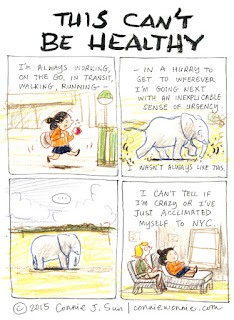
Connie Sun is an Asian-American cartoonist from California, living in New York City. She "works in higher education by day, and loves all things creative." I follow her on her Blogger, where she posts a new cartoon everyday, generating about 1-10 likes per day from her readers. Her cartoons consist of her daily thoughts and pep talks to herself. I first discovered her when my high school friend introduced me to her work after attending a free comic books event in NYC. I continued to follow Ms.Sun because I found her daily comics to be consistently profound and similar to my own experience as a single Asian girl trying to make something out of myself through academics and art while living in NYC. 

Ms. Sun first got into making comics at the get of 29, after she bought her first graphic novel at a comic book store. Before that, she had been reading newspaper comics such as Peanuts and Calvin and Hobbes (1). Seeking a need for a creative outlet for drawing and writing, which she initially distinguished as two different forms of emotional expression, Connie decided to combine the two by making web comics, and has been doing so for about four years. In her own words, "cartoons are an attempt to make sense of what I see and hear and feel at a given time". Besides her desire to understand her own thoughts and behavior in relation to the general human experience, her comics also illustrate her desire to understand animal behaviors since she grew up without pets back in her hometown in Los Angeles. For example, one of the recurring characters in her cartoons is an elephant who gives her pep talks and keeps her company.  

Drawing from personal experiences, Connie's character serves as a reference point, a cue that she is writing from a certain perspective and context. In fact, the theme of all her cartoons, "Single Girl, Asian Daughter", is what makes her works feminist. Although she recognizes and puts out there that she is single, she doesn't devalue herself. Instead, she tracks the source of her thoughts, such as her traditional Asian parents' influence, and self reflects on her environment in order to make sense of why she thinks these things and how she deals with these thoughts. Her work is also feminist in that , even though she claims to be an introvert, she exercises her agency to represent herself through a medium with which she is comfortable receiving criticism from. Connie recognizes that part of the process of being an artist is consistently making deadlines, despite the quality and resulting satisfaction or otherwise, and letting things go in order to move forward. By letting things go, she gives herself the power to continue updating her blog with comics of her latest thoughts, which give people either a new view on life, or the unanticipated realization that we are all the same in major and profound ways. Below, I've compiled a few of her comic strips which pass the Bechdel Test:

Sometimes Connie talks to herself about herself.
Other times, you'll find cartoons of Connie talking to another female. #passesbechdeltest

A typical phone call with her mother. Featured on Angry Asian Man. #passesbechdeltest
But most of the time, you will find cartoons of her talking to her elephant friend. This comic touches upon the issue of climate change.


Beyoncé, a Feminist

As I was doing research for this post, I noticed that I knew almost no famous or even indie female directors besides Ava Duvernay and Lena Dunham.  Even scrolling through lists of top female filmmakers only elicited a name or two that I could recall.
From Metacritic.com
 Therefore I decided I'd rather discuss the portrayal of Feminism in the media and tackle it from a different lens; music.  First, we must analyze the feminist movement and how it has been bastardized since its inception.  Bell Hooks describes feminism in her essay “Feminism: a Movement to End Sexist Oppression” as “a struggle to eradicate the ideology of domination that permeates Western culture on various levels as well as a commitment to reorganizing society so that the self-development of people can take precedence over imperialism, economic expansion, and material desires” (Hooks, p. 25).  With this definition of feminism, Hooks is attempting to broaden the scope of who should be affected by the movement and thus opening the movement to more types of people. Historically, Hooks asserts, feminism has alienated many groups of people.  This includes men, as some feminists see them as the enemy, and nonwhite women, because the only people who benefit from being equal to the men of their race or class are white women.  As such, feminism has been contorted and misconstrued over time, by the media, by its critics, by the naĂŻve leaders of the movement and by all those feminism has turned its back on.  It is quite unfortunate that this shift has occurred; feminism has an immense potential for positive change in almost everyone’s lives.


Even today, celebrities are misguided as to what feminism truly represents and they let the term fall by the wayside.  Their ignorance pushes more people from the movement and ultimately hurts the little girls that look towards these women for guidance.  However, there are some champions for feminism within popular media and the most influential of these is BeyoncĂ©.  Her songs consistently maintain a feminist viewpoint and she makes direct references to it.  “Feminist” was in big bright letters behind her during her VMA performance and an audio clip of Chimamanda Ngozi Adichie speaking about feminism is featured on her song “Flawless.”  This song in particular is an excellent example of her unique approach to feminism.  To analyze this song through a feminist lens, Adichie’s speech must be juxtaposed with BeyoncĂ©’s lyrics and image.  Primarily, BeyoncĂ© sells her brand using sex appeal, this is an undeniable fact, but that should not disparage her message.  Critics may argue that her sexually charged lyrics, performances and videos only hurt the feminist movement as it gives in to the patriarchy and male gaze, but I believe it only serves to strengthen her view of feminism.  During her VMA performance, she pole-danced in a substantially revealing outfit.  However, she immediately followed it with the clip of Adichie saying “We teach girls that they cannot be sexual beings in the way that boys are.” 
Beyonce is a Feminist, despite what others say
With that clip, BeyoncĂ© successfully baited and trapped her detractors with the Madonna/Whore paradox.  Feminists who say she is supporting the patriarchy by dressing or acting like a “slut” are hypocrites who contribute to the patriarchy’s suffocation of female sexuality.  BeyoncĂ© advocates for women to take charge of their lives, which includes sexuality.  She’s not dancing on stage for anyone but herself.  The hook from “Flawless” executes this idea perfectly, “We flawless, ladies tell ‘em, I woke up like this.”  Its an amazing feminist jab, women shouldn’t be putting all that make up on for the benefit of their man, they should do it for themselves so that feeling of self-confidence can permeate their being to the point that it becomes a part of who they are.  Eventually, they’ll just wake up feeling flawless everyday.  

However, BeyoncĂ© can’t always go it alone and admits that her partner is necessary for her to do well.  Adichie agrees that “marriage can be a source of joy and love and mutual support” but she finds that marriage is usually one-sided and that women cannot intimidate the husband with their own aspirations.  BeyoncĂ© uses her marriage with Jay-Z as an example of a relationship that can become greater than the sum of its parts.  Her song “Drunk In Love” is more than just about having drunken, wild sex. 
Their marriage is far from perfect, but
Hova is never intimidated by a strong woman
It’s about having a loving monogamous relationship that makes both participants feel supported and good about themselves.  “Flawless” also touches upon this idea with lyrics like “my man made me feel so goddamn fine” and “this diamond, flawless” referring to her wedding ring.  Yet, she doesn’t want anyone to think Jay-Z is her only avenue to greatness, “…don’t think I’m just his little wife, don’t get it twisted…”  BeyoncĂ© is her own autonomous being, but she still reaps the benefits of being in a loving relationship with someone else.  Her vision of feminism may not be as radical as Hooks, I don’t think she’ll ever start advocating total reorganization of our society’s hierarchy, but she wants to try to include everyone in feminism.  All women should feel flawless, have a sense of personal ambition and self-determination and they should all have loving respectful partners to support them in their endeavors, and that requires getting men involved with feminism.

Citation:
Beyonce MTV Vanguard Award Performance
bell hooks, “Feminism: a Movement to End Sexist Oppression”