Sunday, November 15, 2015

New Final Project Proposal: Armored Fems

On Saturday November 7th 2015 I was attacked by an intoxicated man while I was entering my own building. I made several mistakes which allowed him to think he could get away with trying to sexually attack me. I keep thinking back about all the things I could have done to prevent it. Even while he was following me, liquor on his breath his sweaty body pressing against me I was still finding ways to defuse the situation so I didn't have to burden anyone. I didn't want to wake my father, scare my mother or aggravate my neighbors. I blamed myself to an extent, and didn't even want to hurt my aggressor because he was intoxicated. Once we reached my door he tried to get on top of me and when my mom appeared he tried to choke her. After grabbing him by the neck and locking the door I called 911. The authorities showed up and let my attacker walk free without a report because it was an "isolated case."

I immediately started to write about it and posted the my story in social media. I was frustrated and felt like I didn't know what was going to happen next. What if I ran into my attacker again while he was sober and he decided to try again? I felt cheated by the NYPD and now I was hoping to expose the system which had failed me. I wrote my piece and submitted it to multiple publications and none of them got back. Perhaps it was my writing skills, or perhaps it was the subject of the matter and how queer afro-latinos don't seem to matter in the media. So for my final project I have decided to create my own kind of media. That's how Armored Fems was born.
Rihanna's Gun Tattoo inspired the name

Armored Fems is an activist social media group which is seeking to create a form of media to combat rape culture, meminist and the patriarchy as a whole. I want to unify creative minds who are creating feminist media, sharing their stories and playing active roles in the community. I am currently contacting groups of creatives so that I may feature their work on Armored Fems. I have a Facebook page, Tumblr, and Instagram set up for Armored Fems. I'm gonna be focusing mostly on Instagram because I feel like it is the best platform to reach as many young people as possible. I want to create a network of activist who are trying to create new media that combats the issues in our society.

I am hoping to publish my first article soon so that I can get the blog going, as well as work on a video project and get some art up online.

Saturday, November 7, 2015

Post 4


            There are confusing messages that are imposed on women relating to the image of femininity, beauty, and sex. Mixed messages are created and become unrealistic standards. Society wants us to be an unrealistic balance of "sexy, but not overly-sexy because then you are a slut" kinda woman. When a woman is seen as being “too much” or “too little” of something such as her sexuality, femininity, and verbal and physical expressions, there must be a force that needs to stop her from doing so. Body policing are laws imposed on woman from expressing their body, in their own way. However, why must their be ownerships and regulations upon another human’s body?
              Since we live in a patriarchal society, the goal for policing a woman’s body is to maintain proper conduct and limit women from portraying themselves differently from others. The maintanance of proper conduct is intended for the man. It is in order for the man not to perform in acts of violence, sexual abuse, or sexual harassment against women. As women, when we show our skin, express how sexual we, or do not conform in the society’s views on beauty standards we are seen as rebellion against patriarchy or tempting the man.
              The discussion upon men and what they should not do is barely discussed in our education system, and even in the political world. The light is always on the women to not conform in these acts instead of the man who does. The view points of politicians also create this image of women exaggerating and being dramatic when it comes down to body policing issues. In this article, politicians are quoted on things they have said about women's bodies, and as horrible as they quotes are they are still allowed to be Senators, mayors, and representatives. Rape culture is seen as a joke, Mike Huckabee says "sometimes people conceived by a rape grow up to be really awesome! Rape is inexcusable and indefensive" but man can it produce top-notch humans." 
              School dress codes are one of the many ways in which the "higher authority" makes rules on what young girls are supposed to wear. Girls who violate dress code are punished, humiliated, and are often left with guilt and confusion. Ultimately, their outfits are as important as the education they receive. In South Carolina, students from Charleston County School, protested against the new school dress code policy. A student reported to the Huffington Post stating that, "the teachers at our school insert their own comments like 'you're selling yourself in the wrong way' or 'you're asking for it,'".

        In high school, I spent many school days in detention because I violated the dress code in one way or another. My hair color (red), and nose piercing was the topic of discussion when it came to going to school. The color of my hair and my piercing reflected negatively to the school because it was damaged the school look. Although, I understood it was a private institution, I could not help but to think of how ridiculous the rule was. My attitude and mentality towards my education was not going to change because of the color of my hair or my nose piercing. I was still the same girl. I was threaten with suspension until I changed my hair color back, and took my piercing off. So I did. At the time, I felt like I did not have a choice because my parents were involved as well. Why does the way I looked diminish what the school stood for? was my hair a sign of delinquency? rebellion? Did my appearance take away and lessen me as the young and educated girl I was suppose to be?
      Body policing is reflected upon our everyday media, and we since we are the creators of our media. For example, the standards of the beauty and fashion world is a perfect example to demonstrate what women should and should not look like in a general sense. Some female journalist and fashion gurus impose rules on women such as “things not to wear on first dates". In the article, one fashion guru says, “High-wasted jeans. Guys don't like the way your butt looks in them, unless maybe you look like a Victoria’s Secret model—even then you’re pushing it.” Although articles like these seem minuscule and trivial to the world we live in, it is apart of society and how women look at themselves when they read these articles.
          Self deprecation is what we know how to do because society has filled our heads with the motto of "perfect is never enough". We are conditioned to cover our flaws because our flaws are seen as a vulnerability and weakness. Women create these pieces of media because society makes it okay.  As Berger says, "Men look at women. Women watch themselves being looked at. This determines not only most relations between men and women but also the relation of women to themselves. The surveyor of woman in herself is male: the surveyed female. Thus she turns herself into an object -- and most particularly an object of vision: a sight (Berger)".


Works Cited
John Berger Ways of Seeing

Post 4

            There is a constant pressure for girls to dress a certain way, and to act a certain way. However, girls are not told of one direct way to be, but rather are given conflicting options that create more confusion in their development. While schools are telling girls to dress more conservatively, the media sends out messages that girls can dress in whatever manner they chose, even if it is revealing. The media ends up glorifying the same clothes schools are trying to condemn. So while schools are trying to press harder on these girls to follow the dress code, the media is trying twice as hard to validate those same clothes schools are trying to steer away from. These conflicting messages not only cause problems with how girls view themselves and other girls, but they as well create problems with how society sees young girls and how society views women. School dress codes and the media enforce an idea that “the female body is spectacle, both something to be looked at, whether real or mediated and to be looked through in the search for feminine identity.” (Body Messages 2) They put girls on display to be scrutinized wherever they go, and to be judged to whether they fit a certain mold within either the school standards or the media’s standards.
           Schools incorporate dress codes to provide a sense of professionalism because it is a learning environment. However, these dress codes vary from school to school, and in some cases may enforce strict dress codes that create large boundaries between what is appropriate and what is not. School dress codes provide a guide to professionalism because education is linked to the working world in which appropriate attire is required. School dress codes are also there to keep boys and girls from becoming too wild, and being responsible for making appropriate decisions in their attire. While girls should have the freedom to dress how they chose, there is a limit to which they should dress responsibly. Provocative clothing may lead to other reckless sexual decisions, which dress codes may devolve students from embarking upon. 
This girl was sent home because her collarbones
 had been showing, and her school
had a strict policy against such
 "revealing"attire. This shows
how extreme dress codepolicies become on young girls.
            While school dress codes have certain necessities, they are sometimes enforced in schools to such extreme degrees that it creates an imbalance in the way boys and girls are being treated in schools. Peggy McIntosh says that “[her schooling] taught [her] to see [herself] as an individual whose moral state depended on her individual moral will.” (McIntosh 1) So schools are teaching girls to take better actions to care for themselves, and to take responsibility for the consequences their decisions lead to. However, this becomes a problem when it is applied to a girl’s decision to wear what she likes, because it is implying that whatever attention or harassment they receive, it is actually their fault and not the fault of the harasser. Girls are constantly told to cover up in order to prevent being a distraction to the male students. They will even be sent home on occasion because of “revealing” attire. This type of protocol implies that boys’ education is far more important than it is for girls. Not only does it place girls’ education on a lower platform, but it also places responsibility on the girls to control the hormonal urges of their male classmates.
Wearing bras is a socially constructed norm in itself, which girls
are succumbed to. Despite being told they need to wear a bra by
society's standards. some girls need a bra because their breasts need that support,
which is a body growth aspect they cannot control. So to shame girls for
wearing bras, which is not necessarily their choice, is discriminatory. 
However, adults who are teaching girls to watch what they wear, should instead be teaching boys to control themselves around girls, whether or not their outfits are physically revealing. Teaching girls and boys throughout their life that it is the girl's responsibility to dress appropriately, will of course cause problems in the future when those kids become adults and become the society we live in. Women will critique other women to unhealthy degrees, and judge them when instead they should be coming together to fight against such criticism on females. Men on the other hand will harass women and not be held responsible for their actions because they were taught that t it is the woman who is responsible to be covered up. The idea that depending on “how a woman appears to a man can determine how she will be treated,” is only reinforced with these dress codes. (Berger 46) So boys may internalize ideas from school dress codes, and start to believe that a woman’s worth is weighted by the clothes she wears. Woman should be allowed to dress how they chose, and not fear that they will be punished for doing so.

            School dress codes and the media are two extreme spectrums on how girls and women are judged based on their clothes. On one spectrum girls are judged for being too revealing with their clothes, while on the other they are judged for dressing too conservatively. These are two molds in which girls have to try to balance, but when both spectrums are fuzzy and too extreme, girls will end up being judged regardless of what they wear. Jean Kilbourne writes, “Most teenagers are sensitive to peer pressure and find it difficult to resist or even question the dominant cultural messages perpetuated and reinforced by the media. Mad consumption has made possible a kind of nationally distributed peer pressure that erodes private and individual values and standards.” (Kilbourne 122) Teenagers and pre-teens absorb ideas that are projected by school’s dress codes, and those by media images, so they end up not having their own judgment of what is alright for girls to wear. Due to these bombardment of ideas from the two spectrums, teenagers internalize such ideas and react with judgment when they see girls not fit the mold one or the either spectrum has created. School dress codes and media images essentially cause teenagers to judge women, and it brings about such peer pressure to have to fit into a certain mold to avoid such judgment.


Citation: 
John Berger : Ways of Seeing
Peggy McIntosh : White Privilege: Unpacking the Invisible Backpack 
Maggie Wykes, Barrie Gunter : Body Messages 
Jean Kilbourne : Beauty and the Beast of Advertising 

Thursday, November 5, 2015

Ovarian Feuds: Featuring Old White Men (for some odd reason)

It took me a while to write this because I didn't know what I wanted to focus on and how to go about such a huge issue. As a person who is not biologically female I cannot speak from experience and my opinion is only as valid as my research and understanding.Having male privilege I will never be as discriminated  women are about their bodies every day. Although I may experience discrimination due to my femininity and how I dress, it is not the same way women are treated daily. 

Now that I have stated my privilege and have clarified my comprehension of the issue it's time to tackle the root of it, sexism. Sexism is defined by the Oxford English Dictionary as "Prejudice, stereotyping or discrimination, typically against women, on the basis of sex." Sexism is what fuels the bigot into believe their sex is superior to the other. Women face sexism more often than men due to the fact that our patriarchal society uphold men and oppresses women. This patriarchy is what allows the objectification of women and what allows men to feel entitled to their sexist behavior.

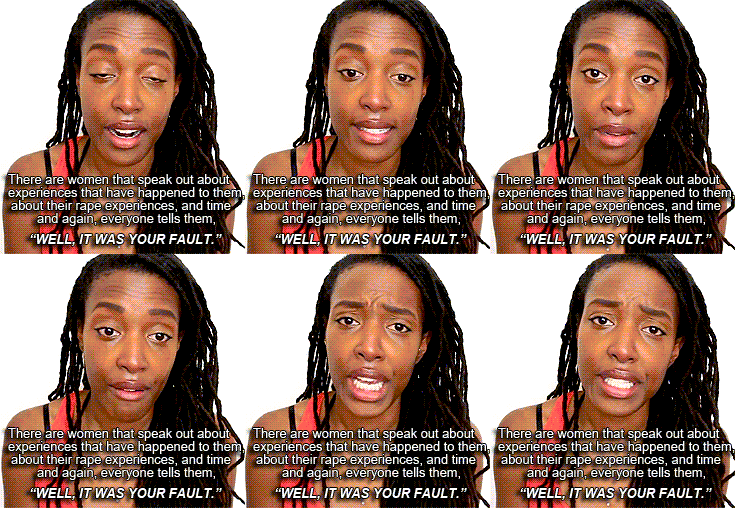
A great example of sexism is this social experiment. This project depicted a woman being verbally abused for dressing however the way she goddamn pleased. The actor playing the role of the bigot is very convincing and the point is to see how people would react to a man being offensive to a woman and how they would intervene. When the man appears to be more violent people tend to avoid the issue and dismiss it until an act of violence occurs.The fact that people went about their lives while this man was screaming sexist slurs at this woman, shows how wrong our society really is. The core issue of his argument is "she is dressed like a slut." This argument is so problematic because victim blaming has been used to justify rape and other acts of violence.

Victim Blaming
This notion is implemented early on in our society. I remember hearing as a kid women in my family telling young ladies that respectable girls covered up, and that men wouldn't take women seriously. What this is doing is placing the blame of men's action solely on women and not taking into consideration that "provocative wear" should not be factored in as a cause of rape. This also translates into the school system. Dress code for me sucked because I hated conforming to gendered clothing, but for girls it is much more than that. Girl's body are sexualized by the school and they are punished, at times sent home, for wearing things which would be too "distracting" for men. This puts the learning of young women second to that of young men. Men are not being held accountable for their actions and instead women's bodies are to blame. 

Women's bodies are not treated the same way men's bodies are treated. When it comes to reproductive rights a woman's body is not her own. She is not allowed to do with her body as she pleases due to all the intrusive laws which some states have. Laws that police what a woman can and cannot do with her own body even though it is a basic human right. She is instead seen as a reproductive machine and this is the what's valued the most over her own rights. 

The most messed up thing about this is that the people deciding on these laws and legislations are predominantly white rich men. This is the most confusing part, why should men decided what women do with their reproductive organs? Do these men have uteruses that we don't know of and are able to make statements such as "women should carry stillborn fetuses to term because cows and chickens do it too."(Gay 272). This man voicing his opinions on what's "right" is another way in which sexist laws are implemented in our society. He is comparing women to farm stock and by doing so he is reducing her worth, dehumanizing her.


Golden scene from Veep.
Abortions have been demonized by society. People have considered it a form of murder even when giving birth could run the risk of the mother dying. Not only were the mother's depicted as villains but so were the women who assisted them "During ancient times women used jellies, gums, and plants both for contraception and to abort unwanted pregnancies. These practices continued even into the 1300s. When Europe needed to repopulate and started to hunt "witches" and midwives who shared their valuable knowledge about these contraceptive methods." (Gay 258). The demonization of people who provide these services and women who get them is institutionalized misogyny. Government getting involved in abortion laws is the equivalent of it getting involved in private affairs. Making women get ultrasounds, listen to the baby's heartbeat and extensive restrictions on the matter is meant to discourage the woman and does not value her decision. 

Overall the government does not care about women (don't even get me started on women of color who are stereotyped and slut shamed more than white women when they get abortions). This treatement of the female body is then implemented into the way the media depicts women. This oversexualization of the young female body is seen on magazine
Britney Spears for Rolling Stone March 2011
covers and on tv shows. The fetishzing of these bodies is then used to justify acts of violence which then lead to teaching young girls not to draw unwanted attention. Women have to live in fear instead of rape culture being dealt with. 


The media also depicts certain women in different ways. It drives different messages into our brain and recreates images we have seen before. Women who are "Straw Feminist" are also seen as castrators and misandrist, these are the women to most likely bring up real issues and then add misandry into the mix, therefore discrediting them. 

We have seen good example of great icons who have spoken up in the media. Orange is The New Black is an example of media which tackles women's issues and focuses purely on their stories. It is a safe space which shows sisterhood in a community which has been outcast for committing crimes. If we get more media like this and How To Get Away With Murder it brings feminist issues into the home and provides strong female roles for young women. Shows like Veep making that joke we previously discussed opens up the viewer's eyes to a serious issue. This is what we we need from our media.

Post 4- Still Not Asking For It

Between our readings, class discussions, presentations, and my own personal review of current media, I cannot help but notice a very common and consistent theme. Society as a whole has not evolved enough to the point of moving past the harsh policing on women’s bodies. Whether some school administrator calls you out on what you’re wearing, the tabloids dictate the line between what’s considered fashionable and what’s “slutty”, a catcaller on the street harasses you, or even being nitpicked by your own peers, it does not feel like there is any zone of safety for women to have full agency over their bodies. While men are free to look and dress as they see fit, women simply do not have the right to make their own decisions. Men dictate to society the laws and “morals” that women must follow to maintain safety, professionalism, and appropriateness. But how is “appropriate” defined? More importantly, why aren’t women the ones who dictate what appropriate means?
With thirteen years of Catholic school education, I can honestly say that I’ve had heavy exposure to the policing of women’s bodies. On a daily basis I would hear things like “Pull your skirt below your knee!” “Keep that top button on!” or better yet, “Leave something to the guy’s imagination!” This is a Catholic school. And the Deans of the school had no problem suggesting that the way someone might dress justifiably dictates how they should be perceived in the public eye. Unfortunately, comments such as these sow the seeds of patriarchy in the minds of such impressionable lads. If we allow our figures of authority within the educational system to make such statements, are we not perpetuating a self-fulfilling prophecy? Without proper guidance, society is led precisely into the patriarchal cycle that John Berger stated so many years ago, “Men look at women. Women watch themselves being looked at. This determines not only the relations of men to women, but the relation of women to themselves.” 
Just one example of the fetishization of the Catholic schoolgirl

And as if to add insult to injury, what makes society’s policing of women so effective, so damaging, is in the shaming that they are subjected to. In certain institutions, such as both my elementary school and high school, would go so far as to suspend female students from school, entirely on the basis of what they were wearing. Their stated reasoning for doing so? The young women weren’t following the “dress code;” they weren’t conducting themselves in a manner that accurately represented the school. What they actually mean, however, is that the women weren’t covering their female extremities from head to toe, for fear of intent to distract fellow male peers from their studies. Even worse, still, is how my school administrators brought religion into the mix. With statements like “No man wants to marry a hoochie” and “You should go home and pray”, the students were made to question their self-worth. Aside from personal exposure to the subjugation of women’ s bodies at school, there are plenty of examples in our society of the detrimental affects that our social patriarchal mindset have imposed on our women and girls.
The laws, policies, and standards put in place in our society have only gone to further reinforce rape culture. Advertising media has only exacerbated the issue. Rather than dressing comfortably, women are subjected to the argument of promiscuity. More than several cases of “boys will be boys” cases have occurred within the last year. In other words, many teen rapists are off the hook from their crimes, for little more than being young and naĂŻve, or because the victims were quite simply “asking for it”. Our society tries to decriminalize rape culture by putting the blame on the victims, belittling them. As opposed to just freely dressing in whatever makes you comfortable on any given day, women are portrayed as dressing provocatively, or sensually, as if with some ulterior motive to get someone’s attention. While shameful that women have to fear for their safety on a daily basis, we must also be weary of the emotional impact of such matters.
The subjugation of women isn't limited to race

As Wykes Gunther said in Conclusion: Body Messages and Body Meanings, “The female body is a spectacle, both something to be looked at, whether real or mediated, and to be looked through in the search for feminine identity.” Whether or not a woman wants attention, she has been forced into the spotlight. Both psychologically and emotionally, society is dictating to women that safety isn’t the endgame; re-evaluating your self-worth to be more careful is. The subjugation of women is not a mutually exclusive event. All races of women are affected across the entire spectrum of age. Jean Kilbourne sums up society’s contradictory message to women, to be “sensual, but not too far from innocence…somehow [women] are supposed to be both sexy and virginal, experienced and naĂŻve, seductive and chaste. The disparagement of maturity is, of course, insulting and frustrating to adult women, and the implication that little girls are seductive is dangerous to real children.” It's about time for change. Boys need to be taught that women are not available for their viewing/physical pleasure. Girls need to be taught that their self-worth should not be determined by the opposite sex, and they should turn a critical eye to advertising media, whose “images associate the products advertised with certain socially desirable traits and convey messages concerning the symbolic benefits accrued to those who consume the product…” and all to make a sale (Kellner).

Works Cited
John Berger Ways of Seeing
Wykes Gunther Conclusion: Body Messages and Body Meanings
Jean Kilbourne Beauty and the Beast of Advertising
Douglas Kellner Reading Images Critically

Monday, November 2, 2015

Post 4

  “Men look at women. Women watch themselves being looked at. This determines not only the relations of men to women, but the relation of women to themselves.” –John Berger

“A girl learns that stories happen to “beautiful” women, whether or not they are interesting or not.”  –Naomi Wolf

“We don’t have inalienable rights the way men do.” –Roxanne Gay

“I think that we are still trying to figure out how can we create sexual images, how can we create images of the penis that are loving and tender and are not about domination?” –Bell Hooks  


Women are instructed and absorb early on, that to behave a certain type of way is to be seen as valuable. Women not only watch the way in which men watch them, but also the way in which society deals with varying types of women. Women’s bodies are not only policed by the legislature which legally binds them, but through mainstream culture which provides conflicting ideas. The most contradictory conception being that women are supposed to be sexy, but not have sex.
Symbolic of the Continuous Messages
Women are Told as They Age
About What "Types" Of Women
 Are Held As Valuable
Kilbourne writes, “The [advertising] culture… urges girls to adopt a false self to bury alive their real selves, to become “feminine,” which means to be nice, and kind, and sweet, to compete with other girls for the attention of boys, and to value romantic relationships above all else.” Within mainstream culture, the valuable female, above all else, is feminine. But femininity is not strength. Femininity is passive, is beautiful, and certainly is not promiscuous. Specific narratives are formulated around which types of females are coded as valuable. The traditional American patriarchal narrative illustrates that the value of a female is in her potential to be a wife. She is, and always should be, a support system. Therefore her needs, wants, and desires would preferably never be heard, and if heard, not be a priority.

As a girl matures, she is able to pick up on these societal cues. Many posts thus far have touched upon dress codes within schools. A young girl early on learns that she must police her own body. Clothing becomes a choice of what “kind of person” a girl chooses to be. More revealing clothing is seen as shameful. As one article on school dress codes reports, “We force women to be viewed through a sexual lens, and then we blame them for it” (Ratchford, Vice Article Link). During the stage of adolescence, individuals are already faced with the weight of physio and psychological changes. Women, especially have the mounting burden of coming to understand their developing bodies. These dress codes send the blatant message that school is for boys. Girls should actively police their bodies for the sake of protection and professionalism, so that the sex-crazed boys (you know, boys just being boys) don’t get distracted. To tie in, a few classes ago we discussed the idea of invisibility. To be invisible is to dress modest, and to under-sexualize oneself. To be invisible can be a means of protection against potential harassment (which is bound to take place in a world where women are blamed for their sexuality). However, in a world where the stories only happen to the beautiful, girls become conflicted between dressing to ‘protect’ themselves versus dressing to impress (obviously to impress the boys that we were told to value above all else). Thus there is the repeated narrative, be sexy, but, of course, not too sexy, and definitely do not have sex.

All over the world, women are not included in the conversations regarding their bodies. From religious ruling to political written legislature, women’s bodies and environments are policed. Within the patriarchal narrative, for a women to have sex outside of marriage is reprehensible. Women are slut shamed, and made to feel insecure about following their natural bodily desires. Women who do not follow the patriarchal narrative are hence punished. These women are socially discriminated against, and are faced with the added pressure of government practices which are degrading. With
regards to reproductive rights, women are confronted with the financial burden of birth control or high cost health insurance, depending on the location, scarcity of choice of birth control, and as well depending on the location, access to safe and timely abortions (By timely, suggesting the preventative abortion laws that necessitate waiting periods, counseling, specified “requirements”). With regards to reproductive justice, women are again confronted with financial burdens of high cost health insurance for raising a child (because the Affordable Care Act still has major flaws) in a world which still pays women less than men, and in a country where minimum wage is almost impossible to live off of. Women need to have the ability to choose to do what they want with their bodies, because we are the ones that have to live with our bodies. It seems so simple a concept, but so difficult to initiate in a patriarchal American society which is constantly trying to keep its conservative (indicating traditional patriarchal sexism and racism) roots intact.  

 I chose to include the four quotes at the beginning because they included certain concepts that I kept coming back to as I wrote this blog. Each of the quotes were supposed to resemble the corresponding paragraph. The first quote with the first paragraph and so on and so forth. Now, I chose to end this paragraph with the quote from Bell Hooks. Within her Open Dialogue on Transgressive Sexual Practices, she made the comment about trying to create transgressive sexual images. She asked how can we create images of the penis that are not symbols of patriarchal domination? And to think a little further, and to align it closer with this particular blog, how can we create images of the women's body that are not about objectification? How can we create images of the women's body in action? How can we create images of women and strength? How can we learn how to accept sexual dynamics outside of the patriarchal norm? How can we create images of sexual freedom where women can have sex and do not necessarily have to be sexy? Within the patriarchy frames have been curated to police a women's body, and the constant struggle is where to find liberation outside of it. 

Erasing Pre-Determined Frames


Works Cited 
John Berger: Ways of Seeing 
Bell Hooks: Open Dialogue on Transgressive Sexual Practices at the New School
Roxanne Gay: The Alienable Rights of Women
Jean Kilbourne: The More You Subtract The More You Add
Naomi Wolf: Culture

Links